Simple Ways to Improve Your Focus and Memory
Published: 25 Mar 2026
Focus and memory help you learn faster, think better, and finish your work without confusion. When your mind stays sharp, you stay confident and active throughout the day. Many people lose focus because of stress, distraction, and unhealthy habits.
The good news is that you can improve your mind with simple daily steps. This guide shares the best simple ways to improve focus and memory in a clear and easy format.
Simple Ways to Improve Focus and Memory
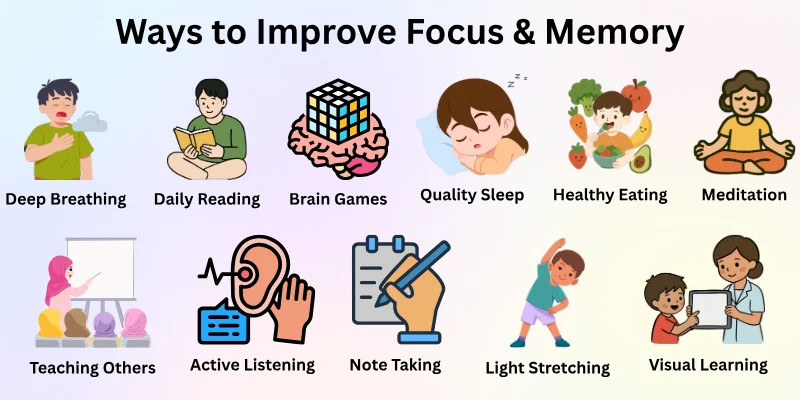
In this part you will cover all the simple methods that help your brain stay clear, active and strong. Here are the simple ways to improve focus and memory that experts recommend:
List of All Methods
- Deep Breathing for Mental Clarity
- Short Goal Setting
- Daily Reading
- Brain Games
- Regular Physical Activity
- Quality Sleep
- Healthy Eating
- Drinking Enough Water
- Removing Distractions
- Time Blocking
- Repetition Technique
- Note Taking
- Mindfulness
- Meditation
- Learning New Skills
- Active Listening
- Organizing Your Space
- Light Stretching
- Spending Time in Nature
- Positive Self Talk
- Social Interaction
- Limiting Screen Time
- Music for Concentration
- Break Technique
- Gratitude Practice
- Journaling
- Prayer or Calm Reflection
- Memory Association Technique
- Teaching Others
- Visual Learning
Let us cover all in detail.
1. Deep Breathing for Mental Clarity
Deep breathing helps your brain relax and receive more oxygen. This calm breath increases alertness. It reduces stress and clears your thoughts. It helps your brain stay steady. It prepares you for better focus. It also supports memory improvement.
How It Works
- Sit straight
- Breathe in slowly
- Hold gently
- Exhale slowly
- Repeat for two minutes
2. Short Goal Setting
Short goals guide your mind in one direction. They remove confusion. They help your brain stay active. They keep you motivated. They train your focus. They reduce mental overload.
How It Works
- Write small goals
- Keep tasks simple
- Complete one at a time
- Tick off after finishing
3. Daily Reading
Reading trains your brain. It improves memory naturally. It builds focus because you follow every word. It keeps your mind active. It reduces mental laziness. It sharpens thinking skills.
How It Works
- Read ten minutes daily
- Choose easy books
- Stay away from noise
- Read slowly and carefully
4. Brain Games
Brain games challenge your thinking. They keep your mind fresh. They train quick decision making. They improve memory skills. They increase attention. They make learning fun.
How It Works
- Try puzzles
- Play memory cards
- Try number games
- Practice for ten minutes
5. Regular Physical Activity
Movement increases blood flow to the brain. It helps you think clearly. It reduces tiredness. It improves mood. It boosts memory. It supports learning.
How It Works
- Walk daily
- Try light exercise
- Stretch your body
- Move for fifteen minutes
6. Quality Sleep
Sleep repairs your brain. It stores memories properly. It protects focus. It balances emotions. It improves learning. It refreshes your mind.
How It Works
- Sleep on time
- Keep room dark
- Avoid screens
- Rest for seven to eight hours
7. Healthy Eating
Healthy food fuels your brain. It strengthens memory. It improves focus power. It keeps you active. It reduces tiredness. It supports long term brain health.
How It Works
- Eat fruits
- Eat leafy vegetables
- Include nuts
- Avoid heavy junk food
8. Drinking Enough Water
Water supports your brain function. Low water makes you slow. It affects memory. It affects focus. It creates headaches. Drinking water fixes this.
How It Works
- Drink small sips
- Keep bottle nearby
- Drink eight glasses
- Drink more in heat
9. Removing Distractions
Distractions break your focus. They weaken memory. They stop your progress. They make your mind tired. Removing them helps your brain stay active. You gain more control.
How It Works
- Switch off notifications
- Work in a quiet place
- Keep phone away
- Use noise free tools
10. Time Blocking
Time blocking gives every task a fixed time. It removes multitasking. It builds discipline. It improves focus. It helps memory store things better. It creates order.
How It Works
- Divide your day
- Choose task time
- Follow schedule
- Avoid extra overlap
11. Repetition Technique
Repetition strengthens memory. It helps your brain remember faster. It builds confidence. It improves learning. It sharpens focus. It keeps information clear.
How It Works
- Repeat points aloud
- Read notes again
- Practice daily
- Review weekly
12. Note Taking
Writing improves memory. It organizes your thoughts. It makes learning simple. It boosts focus. It helps you recall details. It reduces confusion.
How It Works
- Write short notes
- Use simple words
- Highlight key points
- Read notes daily
13. Mindfulness
Mindfulness teaches your brain to stay present. It reduces overthinking. It improves attention. It makes memory stronger. It clears the mind. It improves emotional balance.
How It Works
- Sit quietly
- Notice your breath
- Notice sounds
- Stay present for two minutes
14. Meditation
Meditation calms your mind. It improves focus power. It strengthens memory. It reduces mental noise. It increases clarity. It builds patience.
How It Works
- Sit straight
- Close eyes
- Focus on breath
- Meditate for five minutes
15. Learning New Skills
New skills challenge your brain. They activate memory cells. They increase concentration. They build confidence. They improve problem solving. They keep your mind young.
How It Works
- Learn a new hobby
- Try a new tool
- Practice often
- Keep it fun
16. Active Listening
Active listening means paying full attention. It improves memory. It builds sharper focus. It removes mind wandering. It strengthens understanding. It trains your brain.
How It Works
- Listen without multitasking
- Look at the speaker
- Repeat important points
- Ask questions
17. Organizing Your Space
A clean space reduces confusion. It makes your mind calm. It supports focus. It helps memory find things faster. It improves productivity. It reduces stress.
How It Works
- Keep your desk clean
- Remove extra items
- Use small boxes
- Keep things in one spot
18. Light Stretching
Stretching relaxes your body. It improves blood flow. It supports focus. It refreshes your mind. It reduces stiffness. It improves memory performance.
How It Works
- Stretch arms
- Stretch neck
- Stretch back
- Hold for ten seconds
19. Spending Time in Nature
Nature relaxes your brain. It refreshes memory. It clears negative thoughts. It improves focus. It gives peace. It reduces tiredness.
How It Works
- Walk slowly
- Sit near trees
- Enjoy fresh air
- Observe surroundings
20. Positive Self Talk
Positive words guide your brain. They improve confidence. They remove fear. They support focus. They strengthen memory. They help you trust yourself.
How It Works
- Speak kind words
- Replace negative thoughts
- Encourage yourself
- Practice daily
21. Social Interaction
Talking to people keeps your brain active. It supports memory. It improves mood. It reduces pressure. It builds clarity. It improves communication.
How It Works
- Talk to friends
- Join groups
- Share ideas
- Spend time with kind people
22. Limiting Screen Time
Too much screen weakens focus. It reduces memory speed. It distracts the brain. It causes tiredness. Limiting screens helps your mind rest. Your focus increases.
How It Works
- Reduce phone use
- Take screen breaks
- Turn off extra apps
- Avoid screens at night
23. Music for Concentration
Soft music relaxes your brain. It improves focus. It builds calmness. It helps memory work better. It removes background noise. It helps you study better.
How It Works
- Choose soft music
- Keep low volume
- Avoid lyrics
- Listen during work
24. Break Technique
Small breaks refresh your mind. They prevent overload. They protect focus. They improve memory storage. They increase energy. They reduce stress.
How It Works
- Work for twenty minutes
- Rest for two minutes
- Drink water
- Stretch a little
25. Gratitude Practice
Gratitude creates positive thoughts. It reduces stress. It clears the mind. It improves focus. It increases memory recall. It builds inner peace.
How It Works
- Write three things
- Say them aloud
- Keep a gratitude note
- Practice daily
26. Journaling
Journaling empties your thoughts. It builds clarity. It sharpens memory. It improves focus. It reduces confusion. It organizes your mind.
How It Works
- Write feelings
- Write plans
- Write goals
- Review weekly
27. Prayer or Calm Reflection
Prayer calms your heart. Reflection slows your thoughts. Both support focus. Both help memory. Both improve peace. Both reduce stress.
How It Works
- Sit quietly
- Reflect on your day
- Say a short prayer
- Stay calm for two minutes
28. Memory Association Technique
This technique links new information to something familiar. It strengthens recall. It improves learning. It supports focus. It trains your brain. It makes remembering easier.
How It Works
- Link words to images
- Connect ideas
- Use simple stories
- Practice daily
29. Teaching Others
Teaching builds strong memory. It increases focus. It clears your understanding. It organizes your thoughts. It helps you remember longer. It improves communication.
How It Works
- Explain a topic
- Teach a friend
- Use simple words
- Repeat until clear
30. Visual Learning
Visuals support memory. They help your brain understand fast. They improve focus. They make learning simple. They reduce confusion. They bring clarity.
How It Works
- Use diagrams
- Use charts
- Watch short videos
- Draw simple images
How To Improve Focus at Work
In this part you will cover simple actions that help you stay focused during work hours.
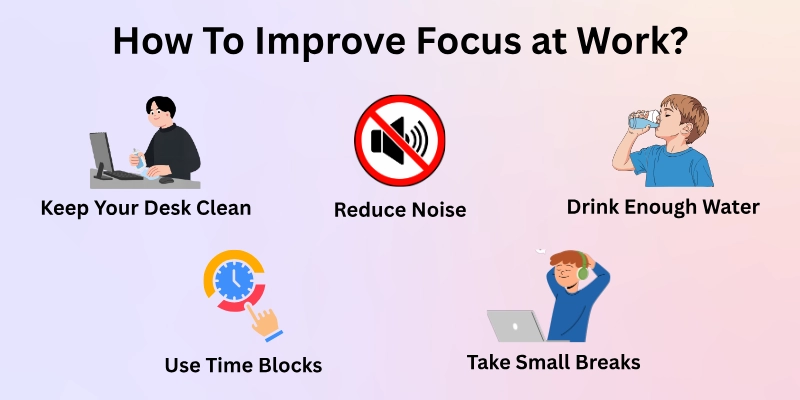
Reduce Noise
- Lower noise to help your brain stay calm and focused.
- Use earphones or soft sounds to block loud areas.
- Close doors or windows to reduce outside sounds.
- Move to a quieter corner when possible.
Use Time Blocks
- Divide your day into small work periods for better focus.
- Set a timer and work on one task at a time.
- Take a short break after each time block.
- Review your progress at the end of the day.
Keep your Desk Clean
- Keep your desk simple to avoid distractions.
- Remove extra items that take your attention.
- Use small storage boxes to keep things neat.
- Clean your desk for two minutes every day.
Take Small Breaks
- Take short breaks to refresh your mind.
- Stretch or walk for a few minutes to reset your energy.
- Close your eyes briefly to relax your brain.
- Drink water before returning to work.
Drink Enough Water
- Drink water to keep your brain active and alert.
- Take small sips throughout the day to stay hydrated.
- Keep a bottle on your desk for easy access.
- Drink a full glass of water in the morning.
How To Improve Memory While Studying
In this part you will cover habits that help you remember study material for a long time.
Use Repetition
- Repeat information many times to make memory stronger.
- Speak or write the same point to help your brain store it.
- Review the topic again after a few days.
- Use repetition for any subject you study.
Use Visual Notes
- Use colors and pictures to understand ideas faster.
- Draw simple diagrams to remember complex points.
- Add arrows and boxes to guide your eyes.
- Use symbols to build fast recall.
Test Yourself
- Test yourself to check what you really remember.
- Use flashcards for quick practice.
- Write short quizzes to challenge your brain.
- Ask a friend to test you for extra practice.
Study in Quiet Places
- Choose a quiet place so your mind stays focused.
- Turn off extra devices that distract you.
- Sit in a simple corner to study peacefully.
- Use earplugs if noise still disturbs you.
Sleep Well After Studying
- Sleep helps your brain save new information.
- Aim for seven to eight hours of rest at night.
- Avoid screens before bedtime to calm your mind.
- Keep your room dark and peaceful for better sleep.
Final Note
In this guide we have covered the most simple ways to improve focus and memory in clear and easy steps that support your brain health. These methods help you stay alert, learn faster, and remember better in daily life.
Try two or three methods each day and build a routine that makes your mind sharp and calm. You now understand the best simple ways to improve focus and memory in your everyday routine.
FAQs: Tips to Improve Focus and Memory
Here are some of the most commonly asked questions related to how to improve focus and memory:
You can improve focus by removing distractions and working in a quiet place. Short breaks help your mind reset and stay fresh. When you set one clear goal at a time, your attention becomes stronger.
Your memory improves when you sleep well, eat healthy foods and practice recall. Your brain becomes stronger when you learn in small steps. Daily habits like reading and solving puzzles also help your memory grow.
Your mind wanders because your brain gets tired or overloaded. You can fix this by taking short breaks and studying in a quiet space. Simple routines like deep breathing help you reset your focus quickly.
Yes, brain exercises help your mind stay active and sharp. Games like puzzles, memory cards and problem solving boost mental strength. These activities train your brain to focus better and remember more.
You can remember better when you use repetition and self testing. Visual notes like diagrams and colors help your brain store information faster. Studying in short sessions also improves long term memory.
You forget things when you feel stressed, tired or distracted. Your memory also becomes weak when you do too many tasks at once. Simple routines like better sleep and calm study habits help your recall improve.
Foods like nuts, fish, fruits and vegetables support brain health. These foods give your mind the energy it needs to stay active. Drinking enough water also helps you stay alert and focused.
Sleep helps your brain save new information and clear old stress. When you sleep enough, your mind becomes fresh and alert. Poor sleep makes you slow and forgetful.
Yes, you can improve memory with simple habits like reading, writing and reviewing. Talking about what you learned also strengthens recall. Your brain gets sharper when you practice these steps daily.
You can stay focused longer by using time blocks and regular breaks. Stretching and drinking water keep your brain active. A clean workspace also helps your mind stay clear and steady.





- Be Respectful
- Stay Relevant
- Stay Positive
- True Feedback
- Encourage Discussion
- Avoid Spamming
- No Fake News
- Don't Copy-Paste
- No Personal Attacks
- Be Respectful
- Stay Relevant
- Stay Positive
- True Feedback
- Encourage Discussion
- Avoid Spamming
- No Fake News
- Don't Copy-Paste
- No Personal Attacks
