Quad Exercises for Bad Knee: Safe Exercises to Strengthen and Support Your Knees
Published: 5 Nov 2026
Many people think they should avoid exercise when they have a bad knee, but avoiding movement completely can make the muscles around the knee weaker. Weak quadriceps can reduce knee support and make everyday activities like walking, standing, and climbing stairs more difficult.
The quadriceps are the muscles at the front of your thighs that help control knee movement and provide stability. Strengthening these muscles with low-impact exercises can support your knees without putting extra stress on the joints.
In this guide, you will learn the best quad exercises for bad knees, along with simple stretches and safety tips to help you exercise with more confidence.
Best Quad Exercises for Bad Knees
Strong quadriceps can help support your knee joint and improve leg stability. The right exercises can strengthen the muscles around your knees while keeping movements gentle and controlled. These exercises are suitable for people who want to improve knee strength without putting too much stress on their joints.
If you are looking for safe ways to strengthen your thigh muscles, here are some effective options:
- Straight Leg Raises
- Quad Sets
- Seated Knee Extensions (Leg Extensions)
- Short Arc Quads (SAQ)
- Wall Sits
- Mini Squats
- Chair Squats
- Step-Ups
- Terminal Knee Extensions (TKE)
- Low-Resistance Leg Press
Let’s look at each exercise in detail and learn how to perform them safely.
1. Straight Leg Raises
Straight leg raises are a simple exercise that helps strengthen the quadriceps without putting too much pressure on the knee joint. This movement keeps the knee stable while activating the muscles at the front of your thigh. It is a low-impact exercise that can help improve leg strength and provide better support for the knee.
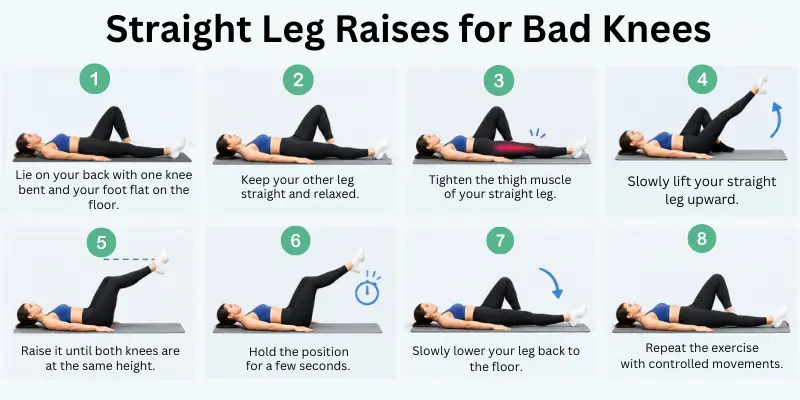
This exercise does not require any equipment and can be done easily at home. It is a good option for beginners who want to strengthen their thigh muscles while avoiding extra stress on their knees.
How to Do Straight Leg Raises:
- Lie on your back with one knee bent and your foot flat on the floor.
- Keep your other leg straight and relaxed.
- Tighten the thigh muscle of your straight leg.
- Slowly lift your straight leg upward.
- Raise it until both knees are at the same height.
- Hold the position for a few seconds.
- Slowly lower your leg back to the floor.
- Repeat the exercise with controlled movements.
Tip: Keep your movements slow and avoid bending your straight leg while lifting. Stop if you feel sharp pain in your knee.
2. Quad Sets
Quad sets are a gentle exercise that helps activate and strengthen the quadriceps muscles without moving the knee joint. This exercise is useful for people with weak knees because it improves thigh muscle control and supports better knee stability.
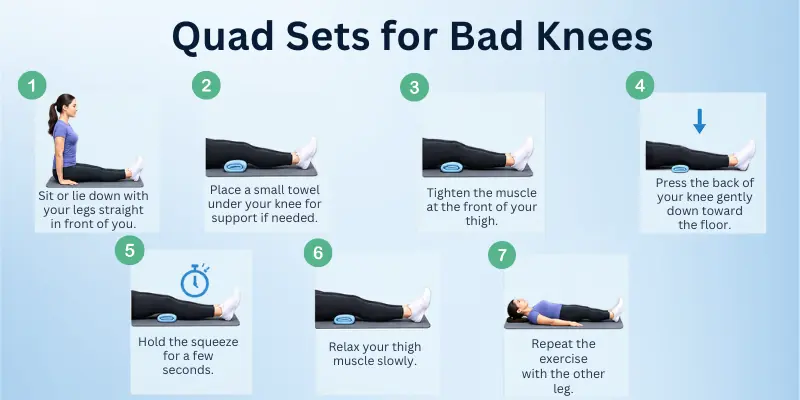
It is a low-impact exercise that can be done while sitting or lying down. Quad sets are often used by beginners because they focus on tightening the thigh muscles without putting extra pressure on the knee.
How to Do Quad Sets:
- Sit or lie down with your legs straight in front of you.
- Place a small towel under your knee for support if needed.
- Tighten the muscle at the front of your thigh.
- Press the back of your knee gently down toward the floor.
- Hold the squeeze for a few seconds.
- Relax your thigh muscle slowly.
- Repeat the exercise with the other leg.
Tip: Focus on squeezing your thigh muscle instead of pushing too hard with your knee. Keep the movement gentle and controlled.
3. Seated Knee Extensions (Leg Extensions)
Seated knee extensions are a simple exercise that strengthens the quadriceps by straightening the knee from a seated position. This movement targets the front thigh muscles and helps improve leg strength and knee support.
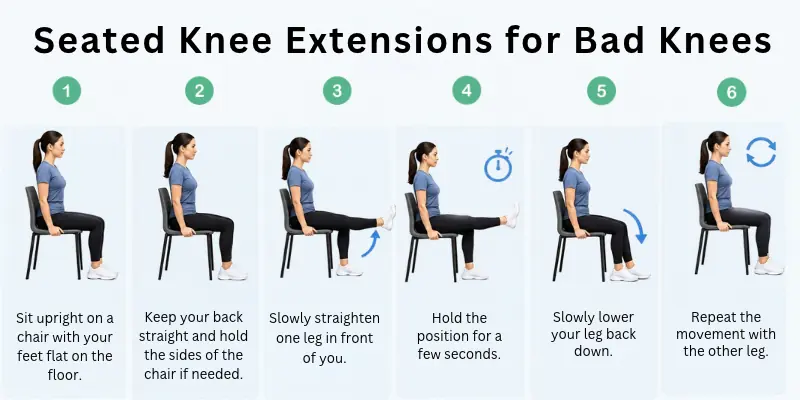
This exercise is easy to perform at home with a chair and does not require heavy equipment. It is a good option for people who want to activate their quadriceps with a controlled movement.
How to Do Seated Knee Extensions:
- Sit upright on a chair with your feet flat on the floor.
- Keep your back straight and hold the sides of the chair if needed.
- Slowly straighten one leg in front of you.
- Hold the position for a few seconds.
- Slowly lower your leg back down.
- Repeat the movement with the other leg.
Tip: Keep your movement slow and controlled while straightening and lowering your leg.
4. Short Arc Quads (SAQ)
Short arc quads (SAQ) are a gentle exercise that targets the quadriceps while using a small range of knee movement. This exercise helps activate the thigh muscles without requiring full knee bending, making it a suitable option for people with weak knees.
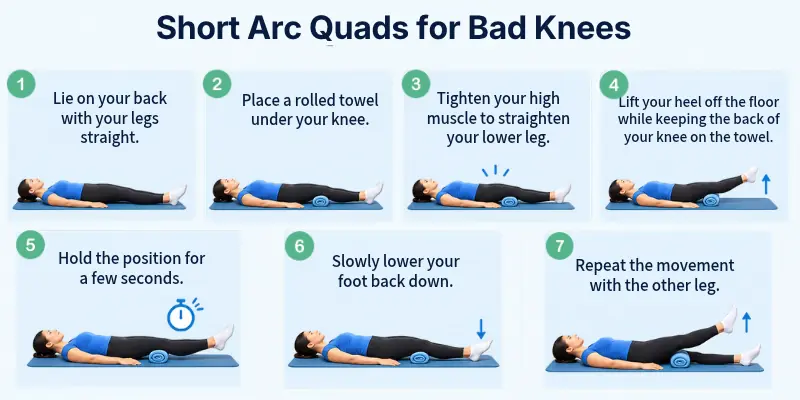
It is usually performed while lying down and requires a rolled towel or foam support under the knee. This controlled movement helps improve quadriceps strength and knee control.
How to Do Short Arc Quads:
- Lie on your back with your legs straight.
- Place a rolled towel or foam roller under your knee.
- Tighten your thigh muscle to straighten your lower leg.
- Lift your heel off the floor while keeping the back of your knee on the support.
- Hold the position for a few seconds.
- Slowly lower your foot back down.
- Repeat the movement with the other leg.
Tip: Focus on squeezing your thigh muscle before lifting your lower leg.
5. Wall Sits
Wall sits are an isometric exercise that helps strengthen the quadriceps by holding your body in a fixed position. This exercise activates the thigh muscles and helps improve leg strength without requiring repeated knee movements.
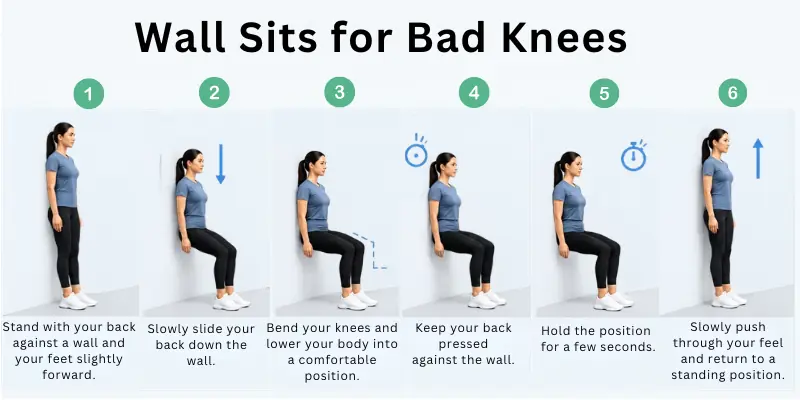
It is a simple bodyweight exercise that can be done at home using a wall for support. Wall sits can help build endurance in the quadriceps and improve control during daily activities.
How to Do Wall Sits:
- Stand with your back against a wall and your feet slightly forward.
- Slowly slide your back down the wall.
- Bend your knees slightly and lower your body into a comfortable position.
- Keep your back pressed against the wall.
- Hold the position for a few seconds.
- Slowly push through your feet and return to a standing position.
Tip: Start with a shallow bend and increase the hold time as your quadriceps become stronger.
6. Mini Squats
Mini squats are a gentle version of traditional squats that help strengthen the quadriceps while using a smaller range of motion. This exercise works the front thigh muscles and helps improve leg strength and knee support without deep knee bending.
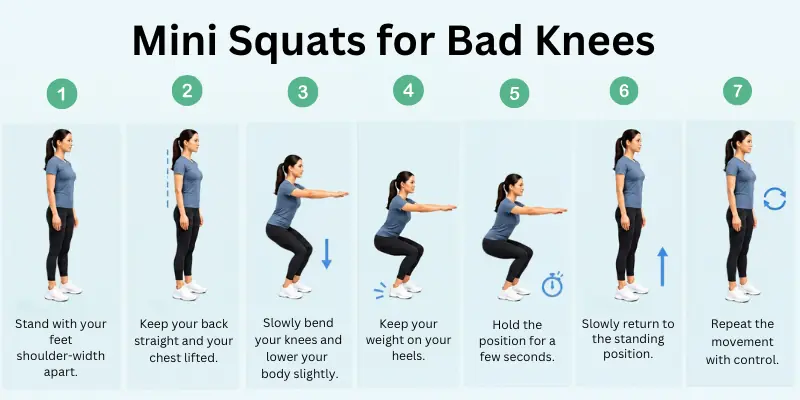
It is a beginner-friendly exercise that can be done at home without equipment. Mini squats help train the muscles used for daily activities like standing up and sitting down.
How to Do Mini Squats:
- Stand with your feet shoulder-width apart.
- Keep your back straight and your chest lifted.
- Slowly bend your knees and lower your body slightly.
- Keep your weight on your heels.
- Hold the position for a few seconds.
- Slowly return to the standing position.
- Repeat the movement with control.
Tip: Keep your knees aligned with your toes while lowering your body.
7. Chair Squats
Chair squats are a modified squat exercise that helps strengthen the quadriceps, hips, and leg muscles with extra support. This exercise uses a chair as a guide, making it a comfortable option for beginners who want to improve lower body strength.
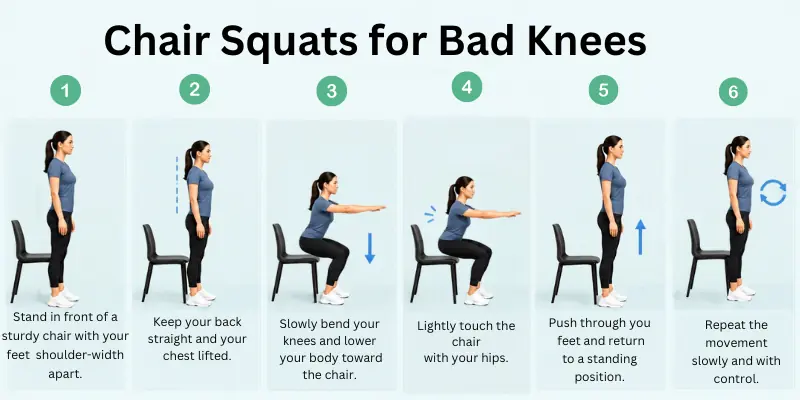
It helps train the muscles needed for daily movements like sitting down and standing up. Chair squats allow you to practice proper squat form while keeping the movement controlled.
How to Do Chair Squats:
- Stand in front of a sturdy chair with your feet shoulder-width apart.
- Keep your back straight and your chest lifted.
- Slowly bend your knees and lower your body toward the chair.
- Lightly touch the chair with your hips.
- Push through your feet and return to a standing position.
- Repeat the movement slowly and with control.
Tip: Keep your knees facing forward and avoid letting them move inward during the squat.
8. Step-Ups
Step-ups are a simple exercise that helps strengthen the quadriceps, hips, and other leg muscles. This movement improves leg strength and balance by copying everyday activities like climbing stairs.
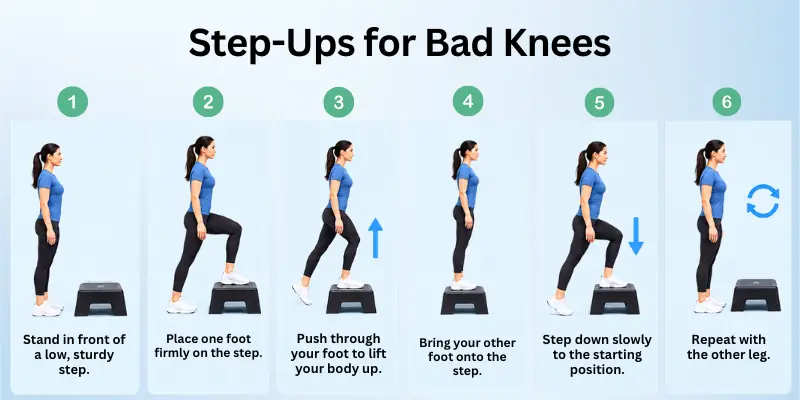
This exercise can be done with a low step or platform at home. It helps build better control of the muscles that support the knee while keeping the movement simple and controlled.
How to Do Step-Ups:
- Stand in front of a low step or sturdy platform.
- Place one foot firmly on the step.
- Push through your foot and lift your body upward.
- Bring your other foot up to meet the first foot.
- Slowly step back down to the starting position.
- Repeat the movement with the other leg.
Tip: Start with a low step height and focus on pushing through the front leg.
9. Terminal Knee Extensions (TKE)
Terminal knee extensions (TKE) are a resistance band exercise that helps strengthen the quadriceps during the final part of knee straightening. This movement focuses on improving knee control and activating the muscles that support the joint.
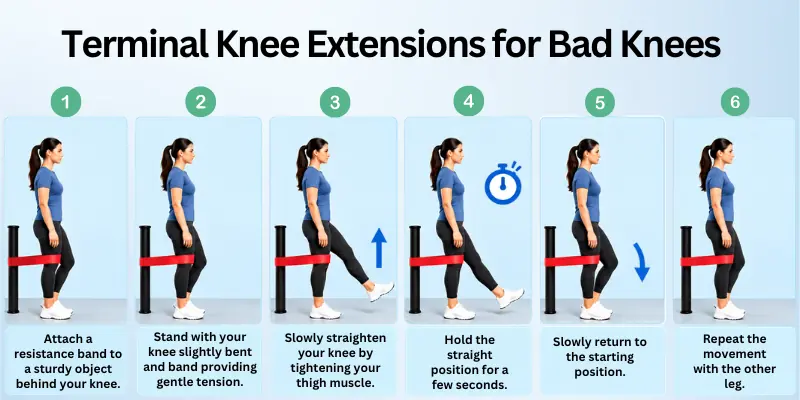
This exercise uses a small range of motion and can help improve quadriceps strength. It is often used as a gentle strengthening exercise for people who want better knee stability.
How to Do Terminal Knee Extensions:
- Attach a resistance band to a sturdy object behind your knee.
- Stand with your knee slightly bent and the band providing gentle tension.
- Slowly straighten your knee by tightening your thigh muscle.
- Hold the straight position for a few seconds.
- Slowly return to the starting position.
- Repeat the movement with the other leg.
Tip: Keep your upper body still and focus on fully tightening your quadriceps during the knee extension.
10. Low-Resistance Leg Press
Low-resistance leg press is a strengthening exercise that targets the quadriceps and other lower body muscles while using controlled pressure. This exercise can help improve leg strength and support the muscles around the knee when performed with light resistance.
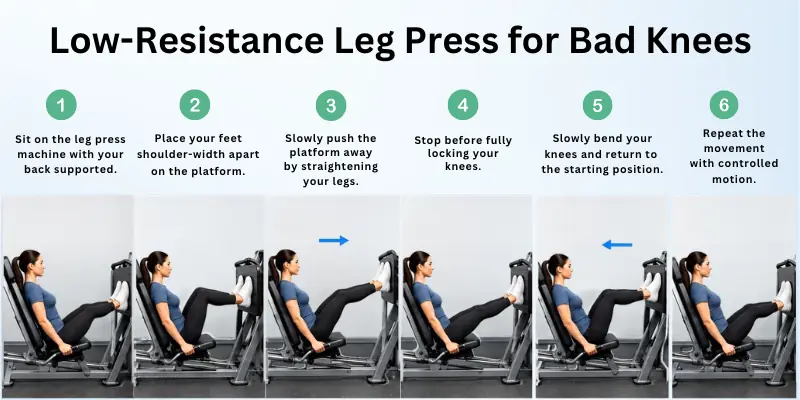
It is usually done on a leg press machine and allows you to strengthen your legs in a supported position. Using low resistance helps keep the movement comfortable and reduces unnecessary stress on the knees.
How to Do Low-Resistance Leg Press:
- Sit on the leg press machine with your back supported.
- Place your feet shoulder-width apart on the platform.
- Slowly push the platform away by straightening your legs.
- Stop before fully locking your knees.
- Slowly bend your knees and return to the starting position.
- Repeat the movement with controlled motion.
Tip: Use light resistance and focus on a smooth pushing movement instead of lifting heavier weight.
Quad Stretching Exercises for Bad Knee
Stretching exercises can help improve flexibility and reduce tightness in the muscles around the knee. Flexible thigh muscles allow smoother movement and support better leg function during daily activities.
Adding gentle stretches along with quad strengthening exercises can help maintain better mobility and muscle balance.
1. Standing Quadriceps Stretch
Standing quadriceps stretch helps loosen the muscles at the front of your thigh. This stretch can improve flexibility and reduce tightness in the quadriceps, which may support better knee movement.
It gently stretches the thigh muscles and helps maintain a better range of motion in the legs. This exercise is simple to perform and can be added after quad strengthening exercises to relax the muscles and improve flexibility.
How to Do Standing Quadriceps Stretch:
- Stand upright and hold a wall or chair for support if needed.
- Bend one knee and bring your heel toward your buttocks.
- Hold your ankle gently with your hand.
- Keep your knees close together.
- Hold the stretch for a few seconds.
- Slowly release your leg back to the starting position.
- Repeat with the other leg.
Tip: Keep your upper body straight and avoid pulling your heel too forcefully.
2. Hamstring Stretch
Hamstring stretches help improve flexibility in the muscles at the back of your thigh. Tight hamstrings can affect leg movement, so keeping them flexible may help support smoother knee motion.
This stretch helps maintain balance between the muscles around the knee and improves overall leg flexibility. It is a gentle movement that can be added after strengthening exercises to keep the muscles relaxed and mobile.
How to Do Hamstring Stretch:
- Sit on the edge of a chair or stand with one leg extended.
- Keep your extended leg straight.
- Lean forward gently from your hips.
- Hold the stretch for a few seconds.
- Slowly return to the starting position.
- Repeat with the other leg.
Tip: Keep your back straight while leaning forward to stretch your hamstring properly.
Safety Tips Before Doing Quad Exercises
Doing quad exercises with proper technique can help improve strength while keeping your knees comfortable. If you have a bad knee, small precautions can help you exercise safely and avoid unnecessary strain.
Follow these simple safety tips before starting your workout:
- Warm-up: Prepare your muscles and joints before starting quad exercises.
- Pain: Avoid movements that cause sharp pain or discomfort in your knee.
- Form: Use proper exercise form to perform movements correctly.
- Intensity: Start with low intensity and gradually increase your effort.
- Shoes: Wear supportive shoes to maintain better balance during exercises.
- Stop: Stop exercising if pain or swelling increases.
Common Mistakes to Avoid During Quad Exercises
Doing quad exercises with the wrong technique can reduce their effectiveness and may put extra stress on your knees. Avoiding common mistakes helps you perform each movement safely and get better results.
Keep these mistakes in mind while doing quad exercises:
- Speed: Avoid doing exercises too quickly because controlled movements help activate your muscles properly.
- Resistance: Do not use too much resistance, especially when you are starting out.
- Depth: Avoid bending your knees too deeply if it causes discomfort or strain.
- Pain: Do not ignore pain signals during exercise and adjust the movement when needed.
- Warm-up: Do not skip warm-up because it prepares your muscles before activity.
Conclusion
In this guide, we covered quad exercises for bad knees, including effective strengthening movements, stretching exercises, safety tips, and common mistakes to avoid during workouts. These exercises can help improve quadriceps strength, support knee stability, and make daily movements easier.
Building stronger thigh muscles takes time and consistency. Start with low-impact exercises, focus on proper form, and gradually increase your activity level as your strength improves. Choose movements that feel comfortable and support your knee health.
If you experience ongoing knee pain, swelling, or discomfort during exercise, consult a healthcare professional or physical therapist for proper guidance.
FAQs About Quad Exercises for Bad Knee
After learning about quad exercises for bad knee, you may still have some questions about the right exercises, safety, and how to improve knee strength. Here are some common questions with simple answers to help you understand the topic better.
1. Can quad exercises help with knee pain?
Yes, quad exercises can help strengthen the muscles that support the knee joint. Stronger quadriceps may improve knee stability and make daily movements easier. However, exercises should be done correctly and should not increase pain.
2. What are the best quad exercises for bad knees?
Here are some effective quad exercises that can help strengthen your thigh muscles:
- Straight Leg Raises: Strengthen the quadriceps without putting extra pressure on the knee.
- Quad Sets: Activate the thigh muscles with a gentle, controlled movement.
- Mini Squats: Build leg strength with a smaller range of motion.
- Seated Knee Extensions: Improve quadriceps strength while keeping the movement controlled.
3. How often should I do quad exercises for knee strengthening?
You can usually perform quad exercises two to three times per week for better muscle strength. Give your muscles time to rest between workouts to recover properly. Consistency is more important than doing too many exercises at once.
4. Are quad exercises safe for people with arthritis in the knee?
Low-impact quad exercises can be helpful for many people with knee arthritis. They may help strengthen the muscles around the knee and improve movement. If arthritis symptoms are severe, ask a healthcare professional before starting new exercises.
5. Can I do quad exercises at home without equipment?
Yes, many quad exercises for knee pain can be done at home without equipment. Exercises like quad sets, straight leg raises, and wall sits only require a comfortable space. These movements are suitable for beginners who want simple home workouts.
6. Should I exercise my knee if it hurts?
Mild muscle discomfort during exercise can be normal, but sharp knee pain should not be ignored. Stop any movement that causes increased pain or swelling. Choose gentle exercises that feel comfortable and controlled.
7. How do I strengthen weak quadriceps muscles?
You can strengthen weak quadriceps muscles by performing regular leg-strengthening exercises. Movements like leg extensions, step-ups, and straight leg raises target the front thigh muscles. Start slowly and focus on proper technique for better results.
8. What exercises should I avoid with a bad knee?
Avoid exercises that put too much stress on your knees or increase discomfort. These movements may not be suitable for some people:
- Deep Squats: Avoid deep knee bending that puts extra pressure on the joint.
- Heavy Resistance: Avoid using heavy weights or strong resistance without proper strength.
- High Impact: Avoid jumping or movements that create extra force on the knees.
- Painful Movements: Stop exercises that increase pain or swelling.
9. Can strengthening quads improve knee stability?
Yes, strong quadriceps can provide better support and control around the knee joint. Improving thigh muscle strength may help with balance and daily activities like walking and climbing stairs. Regular strengthening exercises can support overall knee function.
10. When should I see a doctor for knee pain during exercise?
You should consult a doctor if you have severe pain, ongoing swelling, or difficulty moving your knee. Medical guidance is also important after a knee injury or if symptoms do not improve. A healthcare professional can suggest the right exercises for your condition.





- Be Respectful
- Stay Relevant
- Stay Positive
- True Feedback
- Encourage Discussion
- Avoid Spamming
- No Fake News
- Don't Copy-Paste
- No Personal Attacks
- Be Respectful
- Stay Relevant
- Stay Positive
- True Feedback
- Encourage Discussion
- Avoid Spamming
- No Fake News
- Don't Copy-Paste
- No Personal Attacks
